

Andy McDonnell Drew A Line In The Sand (And Then Ran Past It)
When I asked Andy McDonnell what year he started running and what flipped the switch, he didn’t dress it up. He didn’t pretend it was some heroic moment with a cinematic soundtrack. He just told me the truth. You know, the kind of truth most of us recognize immediately because we’ve lived some version of it.
“Yeah, it was… I was 41, so eight years ago, 2017, and just let myself go a lot, basically,” he said.
And here’s the part that lands: Andy wasn’t starting from “nothing happened.” He was starting from years of pain, a knee injury he didn’t address for way too long, and the slow slide that comes when life stacks responsibilities faster than you can recover. Work. Sleep that isn’t sleep. Meals that are just fuel you shovel in between chaos. And then one day you see a photo of yourself and think: I don’t recognize that person.
So Andy did the simplest, hardest thing. He drew a line in the sand. He started eating differently. He started moving again. And he chose a route he used to walk when he was younger. And get this…..he realized it was exactly 5K.
He walked it. Then he ran bits of it. Then more bits. And like so many everyday athletes, he didn’t become a runner by declaring it. He became a runner by repeating the decision.
That’s one of the most searchable truths in endurance culture: how to start running after injury isn’t really about the perfect plan. It’s about building trust with your body again, one small loop at a time. That can be a loop at the track or a loop in your neighborhood. Maybe it’s a loop on the trails by you. This doesn’t have to be cinematic. It just has to be.
The Comeback That Started With 5K
Andy’s early progress didn’t come from chasing anyone else’s highlight reel. It came from showing up when he didn’t feel like it. He built the habit. He added bodyweight strength work at home and kept stacking days.
Then his father-in-law, who had been running most of his life, nudged him into a 10K race in late 2017. Andy’s longest run at that point was just under 7K. The race? Hilly. Two loops. “Each side was a big hill,” he told me, like that’s a totally normal first 10K experience.
Somehow, he survived it. Better than survived it.
He ran the 10ki in 58 minutes. Under an hour.
And that mattered, not because it put him in some special category, but because it proved something very specific: the version of Andy who felt stuck wasn’t the whole story anymore.
That 10K didn’t just mark a comeback. It set a new baseline. This new line in the sand was one he could carry into life beyond the finish line. Because endurance sports doesn’t only teach you how to tolerate discomfort on a hill. They teach you how to tolerate discomfort in general. How to stay present, how to keep moving, how to solve the next problem without panicking about the whole course.
And then Andy did what runners do once they realize they’re capable.
He looked for the next “maybe.”
ADVERTISEMENT
.png)
Chasing A Sub-2 Half Marathon (And Finding More Than A Time)
Before running became his thing, Andy had history with the Great North Run which is one of the biggest half marathons out there. In his mid-20s, he showed up with basically no training and ran it in around 2:12. Then he did it again the next year. Same lack of training. Similar time. Because apparently our twenties are just us doing wild stuff and calling it a personality trait.
Later, after his mom died, he ran it again to raise money for charity. His knee was still an issue. He still got around in about 2:16. And then he told himself he was done.
But a decade later, after that 2017 comeback, the half marathon came back into his head with a new kind of purpose: I want to get under two hours.
So he trained. Gradually. Consistently. And in September 2018 on a hot day, with huge crowds, and water bottles all over the road…..amongst the whole beautiful mess, Andy ran 1:54.
Goal checked.
And if you’ve been around this sport long enough, you already know what happened next.
The “bug.”
The quiet voice that says: Okay… so what else can I do?
Andy told me his favorite distance is the half marathon because it’s the perfect blend of challenge and effort without needing to turn your entire life into a training spreadsheet. And honestly? That’s a very sane approach for a sport that regularly convinces people to run 45 miles in February “as a birthday warmup.”
When Running Became A Mental Reset Button
There’s always a moment in these conversations when the splits fade and the real reason shows up.
I asked Andy why he keeps coming back. Back through divorce, weight changes, injuries, all of it. Why choose running when it would be objectively easier to pick literally any hobby that doesn’t involve your lungs filing a formal complaint?
Andy answered it like someone who has tested this theory in real time.
“Because… it’s a constant in my life. It’s something I can do. I know I can do,” he said. “And you know what it’s like when you’re running… you get that sort of an hour, two hours of time where it’s just you… and you just sit with your thoughts… It’s that escape.”
That’s the part people outside the sport don’t always understand. Running can be physical training, sure, but it’s also emotional processing with sneakers on. It’s where you go when life is loud and you need a place to hear yourself think.
And this is exactly where the theme hits: endurance sports don’t keep their lessons in a neat little box labeled “training.” They spill over into how you parent, how you handle stress, how you show up to work, how you manage the version of yourself that’s cranky when you haven’t moved your body in too long.
Andy told me, “You go out for a run and everything feels a little bit better afterwards.”
Not fixed. Not perfect. Better.
That’s real.
The 24-Hour Pandemic Run And The Power Of Owning Your Pace
During the pandemic, one of Andy’s events got canceled. He was ready for the 24-hour challenge where you run as many loops as you can. So he did what everyday athletes do when the plan falls apart.
He made his own plan.
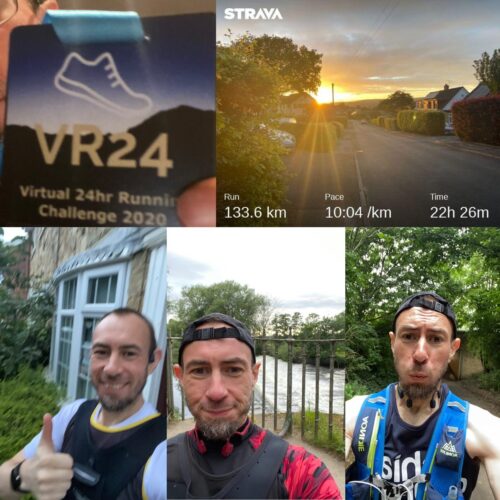
He ran four-mile loops around his hometown for 24 hours. He even warned the village ahead of time, because “they might get a bit worried” seeing a guy running past houses at 1 a.m. in a hoodie.
Naturally, the police stopped him anyway.
They took one look and realized it wasn’t a crime spree. It was just a middle-aged man doing the thing that made him feel alive.
Andy hit 134K.
When I reacted the way any reasonable person would react (“Holy shit”), he just kept rolling forward with the story because to him, it wasn’t about impressing anyone. It was about proving to himself that he could keep going.
And then life shifted again. Divorce, inconsistent training, the reality of trying to balance running with parenting and work and being a human with limits.
But here’s what I love most about Andy’s perspective: he refuses to let social media set his goals.
“We all get… comparison issues,” he admitted. “But… I know what I want to do and I know what I’m comfortable doing.”
He’s competitive within reason. He wants to do well. But he doesn’t want running to swallow his whole life. He wants balance.
And yes, he also wants cake.
I respect the honesty. I trust a runner who admits snacks are part of the plan.
Running With His Daughter: Community Starts At Home
One of the best parts of Andy’s story isn’t a race at all. It turns out to be his Saturday mornings.
In the last 18 months, Andy’s daughter started joining him for 5Ks. Not because he pushed her. Because she chose it.
“I’ve never sort of pushed her into doing it,” he said. “She just said… this is something I want to come along and do.”
And then he said something that hit me right in the feels:
He doesn’t know why she does it. She’s not competitive. She finds it hard. Sometimes she looks miserable mid-run. But she still shows up. And afterward, when she finishes, she’s proud.
Andy sees the bigger win: habit-building, time together, a shared experience that becomes part of how they connect.
They go to a café afterward for cake and hot chocolate, which, just to be clear, is the correct ending to a 5K.
And this is where Andy becomes a kind of coach without needing a title. He’s coaching by example: consistency, patience, boundaries, respect for effort, and the understanding that progress isn’t always measured in minutes.
This is how endurance sports build community. Sometimes it’s a race with thousands of people. Sometimes it’s just you and your kid, side by side, doing something hard on purpose and then celebrating with sugar.
What Andy’s Story Offers The Rest Of Us
Andy didn’t start at 41 because he wanted medals. He started because he wanted his health back and because he wanted to show up for his family as a better version of himself.
He kept going because running gave him clarity, structure, and a way to deal with life when life got heavy.
He learned how to hold goals loosely and still care. He understood how to want more without letting comparison steal the joy.
And now he’s looking toward what’s next: a 45-mile trail run before his 50th birthday, the Malta Marathon as a celebration, and maybe, if he chooses it, scratching the itch of 100 miles someday.
The lesson isn’t that you should copy Andy’s distances.
The lesson is that you can draw your own line in the sand, too.
And then you can take up space on the path—at whatever pace gets you there.
ADVERTISEMENT
