


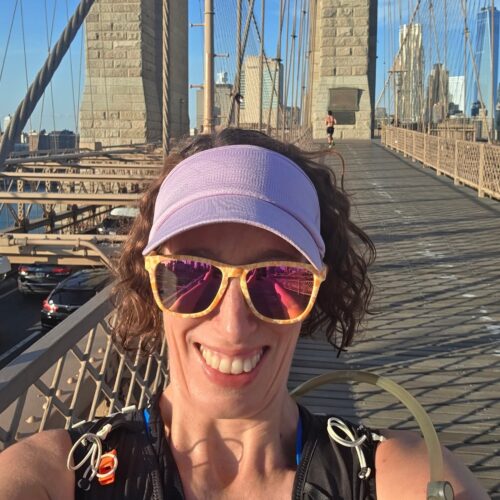
Finding Quiet Through Motion:
Kathleen Smith’s Everyday Runner’s Journey
I’ve learned over the years that the best endurance stories don’t start with finish lines. They start with disruption. A move. A loss. A moment where life feels loud and the only way to soften the noise is to put one foot in front of the other.
Kathleen Smith’s story fits squarely in that space.
When Kathleen and I sat down to talk, what stood out immediately wasn’t her race résumé or the distances she’s covered. It was the why. The way running entered her life not as a goal-driven pursuit, but as a way to steady herself when everything else felt uncertain.
And that’s where this story really begins.
How It All Started: Running as a Lifeline
Kathleen traces her first real steps into running back to around 2012. At the time, she had just moved to Australia…..sight unseen.
“I had a job, but I didn’t know anyone. I’d never even been there before,” she told me. “You think because people speak English it’s easy. It’s not. You’re missing all the subtext.”
She had come from England, landed in Australia with a one-way ticket, and quickly realized how disorienting it felt to rebuild a social structure from scratch. Running wasn’t a passion yet. It was a coping mechanism.
“I needed something to put my mind at rest,” Kathleen said. “So I started running, if you can even call it that. I didn’t know what I was doing. I just put on something stretchy and went out the door.”
It wasn’t glamorous. It wasn’t structured. But it worked. Running gave her a sense of control during a chapter defined by transition and uncertainty.
That early experience planted a seed. This was a seed that would disappear and reappear at different points in her life.
Stops, Starts, and a World That Changed Overnight
After Australia, Kathleen’s life took her back to the United States. Florida came next, followed by New York, which is home thanks to deep family roots in Brooklyn and Queens.
By January 2020, she found herself standing on a starting line for the Dopey Challenge at Walt Disney World, marking her 40th birthday. It was a massive undertaking, especially given where she was physically at the time.
“There’s no way I should have been able to complete it,” she said, laughing. “But I did.”
And then, almost immediately, everything stopped.
Living in Queens, less than a mile from Elmhurst Hospital, Kathleen experienced the early days of COVID from the epicenter. She lost her job and didn’t have health insurance. She didn’t leave her apartment for three months.
“I completely stopped running,” she said. “Completely.”
That pause stretched far longer than anyone expected. What followed wasn’t a dramatic turning point, but something quieter and more familiar to many of us. It was a period of drifting.
“I wasn’t really trying,” Kathleen admitted. “I was just floating. Trying to figure out how I existed in this new version of the world.”
ADVERTISEMENT

Choosing to Come Back
The return didn’t come with fanfare or a big announcement. It came with a Turkey Trot in November of 2023.
“I needed something I could control,” Kathleen told me. “I wasn’t doing it for fitness. There was a need to quiet down my brain.”
That idea stuck with me. Running didn’t fix everything. It created space.
As 2024 began, Kathleen wasn’t chasing a “new year, new me” mindset. She was chasing calm.
“My brain was quiet when I ran,” she said. “That was enough.”
The physical changes followed naturally, but they were never the main driver. Running became a place where expectations fell away. It was a place where pace, comparison, and outside noise didn’t matter.
Progress You Can Feel, Not Just Measure
Kathleen is a self-described data nerd. She tracks her races. She looks at the numbers. But even with all that information, there was one moment that made everything real.
The Fifth Avenue Mile.
“When I started, my mile time was around 17:40,” she said. “At the Fifth Avenue Mile, I ran a 9:10.”
She spent most of that race running alone with faster groups well ahead and slower runners behind. Fifth Avenue, empty around her, became a proving ground.
“That was the first time I really believed it,” Kathleen said. “I wasn’t sad about who was ahead of me. I knew where I belonged in that moment.”
That recognition didn’t come from comparison. It came from ownership.
Why Running Keeps Showing Up
Running isn’t easy. We both acknowledged that during our conversation. There are easier hobbies. Less demanding ways to spend time.
But Kathleen’s answer to why she keeps coming back was simple.
“Because running isn’t the hardest thing,” she said. “Life is harder.”
That perspective reshaped how she approached everything else, especially work. When faced with a six-month professional project, she planned it the same way she plans training.
“I map it out like marathon training,” she told me. “I know which weeks will be tough and where the recovery is.”
Running didn’t stay on the roads. It carried over into how she navigates responsibility, pressure, and uncertainty.
ADVERTISEMENT
“Make It Count”
Late last year, Kathleen received a message from a close friend in Australia. Their cancer had returned. Time was limited.
The next morning, she went for a run.
“Nothing was going right,” she said. “But I kept thinking……just make it count.”
That phrase has become her anchor. A reminder that time matters. Effort matters. Showing up matters.
It’s not about squeezing everything out of every moment. It’s about being present for the ones you have.
Creating Space for Others
Today, Kathleen isn’t just a runner. She’s a member of the running community who believes deeply in inclusion, patience, and personal progress.
Her advice to new or returning runners is refreshingly grounded: focus on your own metrics. Avoid comparison. Find people who welcome you as you are.
“Your pace doesn’t define you,” she said. “Showing up does.”
That mindset reflects exactly what we try to build at Run Tri Bike. We are a community where humility matters more than showmanship, and connection matters more than results.
Kathleen once worried she didn’t belong in endurance spaces. Now she’s helping others take up space without apology.
And that’s how running works at its best. It doesn’t change who you are. It reminds you that you’re allowed to be here.
ADVERTISEMENT
