

Charlotte Schwark: Running, Dogs, and Taking Up Space
When Running Wasn’t the Point
I ask every athlete the same question when we start these conversations: What year did you start running, and what pushed you there?
Charlotte Schwark didn’t answer with a race result or a time goal. She went further back.
January 2020. Breast cancer. Survival. And then a promise to herself that life couldn’t shrink anymore.
Charlotte told me, “I survived this. I’m getting a dog. I need something that gets me moving again.” What stands out isn’t the decision to be active. What stood out was that running wasn’t even on her radar. She was a cyclist. Walking bored her. Running sounded worse.
But life has a funny way of nudging us sideways instead of forward.
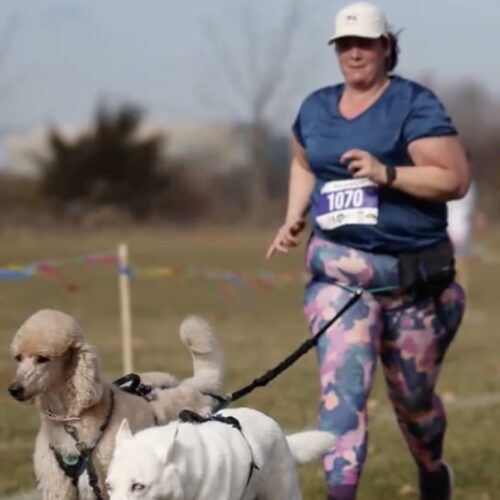
Charlotte adopted a husky mix, fully expecting biking to be their thing. It wasn’t. The dog could go fast, briefly, or slow for longer but biking together never clicked. Instead of forcing it, Charlotte went searching. That curiosity led her to canicross: running with your dog, connected by a harness and leash, moving as a team.
“I didn’t start this for me,” she said. “It was for my dog.”
That detail matters. So many endurance stories begin with ego or ambition. Charlotte’s began with care, patience, and a willingness to try something that didn’t fit her old identity.
She showed up to her first canicross event in early 2023 without training, without expectations, and without any belief that running would become her thing. And yet, she finished. Slowly. Proudly. Hooked.
Finding Community by Showing Up Anyway
Those early canicross races were small. Ten athletes, maybe fewer. By the time Charlotte crossed the finish line, others were packing up. There were no crowds. No spotlight moments. Just the quiet satisfaction of doing something hard and not quitting.
“I don’t care about pace,” she told me. “I show up and I finish.”
That mindset kept her coming back. Even when the local events disappeared, Charlotte kept going even if it meant driving farther, connecting online, and eventually meeting ambassadors from across the country. The community grew because she stayed visible.
Visibility matters. During our Enduring Minds conversation with Zach Friedley, he said ‘We can’t be what we can’t see.’ That statement is also the ethos behind the vision and mission of Run Tri Bike: We are proving that there is a spot at the starting line for everybody and every body.
Charlotte understands that deeply—not just as a runner, but as a leader.
She’s the CEO of her local United Way, stepping into a role after a long leadership gap and carrying a struggling organization largely on her own. Pressure is familiar to her. Expectations live at work. Running, by contrast, became her place to breathe.
Most days, she runs with her dogs. All training runs. Almost every mile. When she decided to run her first half marathon, she did it solo. This wasn’t because she preferred it, but because her dogs couldn’t safely go that far.
The longest run she’d done before race day? Six miles.
“No training plan,” she admitted. “Probably not the smartest choice but it worked.”
That race director adjusted the cutoff so Charlotte could finish. No drama. No judgment. Just support.
“That kind of support changes everything,” Charlotte said. “I didn’t feel like an outlier anymore.”
And that’s where endurance sports stop being about finish lines and start becoming something bigger.
ADVERTISEMENT
Taking Up Space Without Apology
Charlotte describes herself as a back-of-the-pack runner. She’s been to events where the finish line was quiet by the time she arrived. She’s seen awards handed out before she finished. She knows how isolating that can feel.
But canicross, and looped events, changed that experience.
In these races, athletes choose how many loops to run. One loop counts. Three loops count. Being out there still counts.
“There are always people around,” she told me. “Even if I’m slower, the event is still happening.”
That matters more than people realize. It’s not about applause but about belonging.
Charlotte’s running journey didn’t just change her fitness; it reshaped how she sees inclusion. She recognizes privilege in sport and notices who gets represented while noticing who doesn’t.
“I want to be the person now who helps others see that they can do this too,” she said. “Especially when I used to be the one saying, ‘I hate walking.’”
Today, Charlotte invites anyone to join her. She is talking to runners, walkers, people with dogs and people without dogs. She talks to strangers on trails. She’s starting a local canicross group where none existed. She carries cards in her pocket so the invitation doesn’t get lost.
Her dogs are her run club. Some days they want two miles. Some days she does. Either way, the run still counts.
Running isn’t neat or controlled in Charlotte’s world. It’s messy. Boots get lost in the snow. Dogs decide they’re done early. Plans change.
And that’s exactly why it works.
Using Running to Build Something Bigger
This May, Charlotte is organizing her own inclusive canicross race to raise funds for local nonprofits. She’s partnering with My Team Triumph to make sure athletes of all abilities can participate.
This isn’t a side project. It’s personal.
Charlotte lost her son in 2022. Years earlier, she had dreamed of racing alongside him, giving him the same joy she found through movement. That opportunity never came.
So now, she’s creating it for others.
“This race is my way of giving that experience to someone else,” she told me. “Everyone deserves to feel that.”
That belief sits at the heart of endurance sports when we get it right. The lessons don’t stay on the trail. They spill into leadership, empathy, and community care. Beyond that, they teach us how to stay present when life is heavy and remind us that progress doesn’t need permission.
Charlotte didn’t set out to become a runner. She didn’t chase validation or medals. What she did do is follow her curiosity, stay open, and allow growth to happen without forcing it.
Her story is showing up, again and again, while making space for others to do the same.
And that’s exactly why her voice matters.
ADVERTISEMENT
