


Running Together, Growing Together: Mary Crider’s Story
I’ve been doing this long enough to know that most running stories don’t start with fireworks. They start quietly. Awkwardly. Sometimes on a treadmill that hasn’t seen much action. Mary Crider’s story is one of those and that’s exactly why it matters.
Mary didn’t grow up loving running. It wasn’t a childhood passion. It wasn’t a dream she carried into adulthood. Instead, it showed up later, almost accidentally, during a season of life when she simply wanted to move a little more and feel a little better. And in true everyday athlete fashion, that first step didn’t look impressive on paper. It looked like 0.3 miles on a treadmill in October of 2010.
What stands out to me isn’t the distance. It’s what she did next.
How Much Harder Could Running Be
Mary told me, “I already walked. I thought, how much harder could running be?” Anyone who has ever tried running for the first time knows the answer to that question shows up fast and usually in your lungs. Breathing was hard. Everything was hard. But she didn’t stop. She slowed the treadmill down and then added small amounts of time. She went back again the next day.
And then something unexpected happened. Her son came home from college, noticed the wear marks on the treadmill belt, and suggested she sign up for a race.
That nudge changed everything.
Running didn’t suddenly become easy. It didn’t suddenly become joyful. But it became possible.
Mary signed up for a local 5K. Between October and May, she built her way there the only way she knew how. Adding a little bit at a time. No training plans or apps. No buzzwords. Just curiosity, consistency, and survival.
She reached three miles before race day, mostly through run-walking, though she didn’t know that term at the time. When she crossed her first finish line Mary was excited, proud and a little disappointed. She hadn’t run the entire distance. Her asthma flared up. She coughed all the way home.
So she signed up for another 5K.
That second race came with free ice cream at the finish line, which feels like important context. This time, Mary ran the entire distance. It wasn’t fast or flashy. But it was hers. And somewhere between that first race and the second, the idea of finishing, not speed, became the goal.
That mindset stayed with her as distances grew.
ADVERTISEMENT

Learning to Stay in the Game
Mary lives in Tennessee, which means hills. Real ones. The kind that make you question your life choices. She trained where she lived, learning quickly that walking uphill wasn’t failure and that it was part of the process. Before she ever heard about structured run/walk systems, she was already practicing one simply by listening to her body.
“I wanted longer races,” she told me, “because I’m not fast. In a 5K, it felt like everyone finished and I was still out there.”
Longer distances gave her space. Time. A way to work steadily without feeling rushed off the course. She set her sights on a half marathon in Nashville, giving herself a full year to prepare.
Crossing that finish line was different. Her parents came to watch. Mostly, to make sure she didn’t die, she joked. The sense of accomplishment outweighed everything else. It wasn’t about pace. It was about doing something she never thought she’d do.
That feeling kept her coming back.
Mary is a retired teacher, and running became a steady place to put stress when life got heavy. During a difficult professional period filled with uncertainty, running gave her a way to cope when answers weren’t immediate.
Running didn’t fix everything. But it gave her a place to process it.
She told me, “You can walk, you can crawl—whatever it takes—but if you want to do it, you can get there.” That lesson didn’t stay on the roads. It followed her into the rest of her life.
Running as Connection
One of my favorite parts of Mary’s story is how running became something she shares with her daughter although it didn’t start there.
Over time, races turned into small family adventures. Mary’s son is ‘required’ to run one race with her per year because he was the one that nudged her in this direction. If running with her daughter and son wasn’t enough, Mary is now running with her grandson (or as she says, behind him!)
Traveling, running and hiking with your family makes this journey extra special. In 2025, at Javelina, Mary and her daughter ran more than 19 miles together as a way to celebrate Mary’s retirement.
They stayed together the entire race.
Mary’s daughter manages multiple health conditions, and the night format made it possible for her to finish. They adapted. Ice in hydration packs. Slower pacing. Plenty of talking and problem-solving.
Watching her daughter push through something new, as an adult, meant more than any finish time ever could. It was a shared effort. Shared struggle. Shared joy.
Running became a way to stay connected as life changed.
Why She Keeps Running
Mary doesn’t pretend running is magical. She’s honest about the cost, the gear, the chafing products, and the reality that “free exercise” is only true for about five minutes.
But she keeps running because it gives her time alone without isolation. Music in her ears. Space from the noise of life. A way to break hard things into manageable pieces. For example, running mailbox to mailbox or electric pole to electric pole.
She also keeps running because she believes deeply that runners don’t all look the same.
“I’m not a pencil-thin marathon runner,” she said. “Runners come in all sizes.”
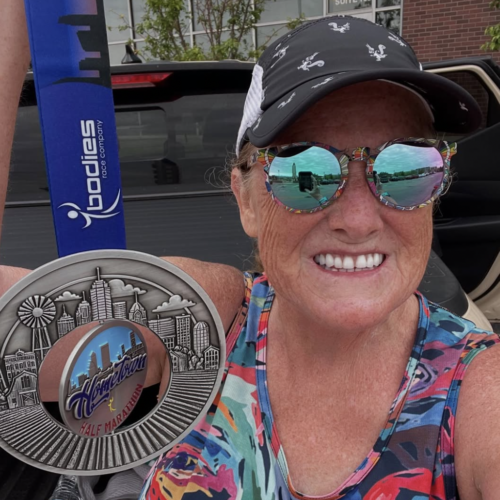
That matters. Especially in a sport that still struggles with gatekeeping. Mary sees medals not as participation trophies, but as proof of effort. Symbols of work done when quitting would have been easier.
And she’s right.
Every finisher carries a story you can’t see from the results page.
The Takeaway
Mary Crider didn’t start running to chase a podium. She started because she wanted to move. She stayed because it gave her tools for parenting, teaching, coping, and connecting.
Her story reminds me why Run Tri Bike exists in the first place. Running isn’t about being the best. It’s about staying in it long enough to let it change you.
And sometimes, it even brings your family along for the miles.
ADVERTISEMENT
