


Submit your story here.
Robert Brooks Started With Courage
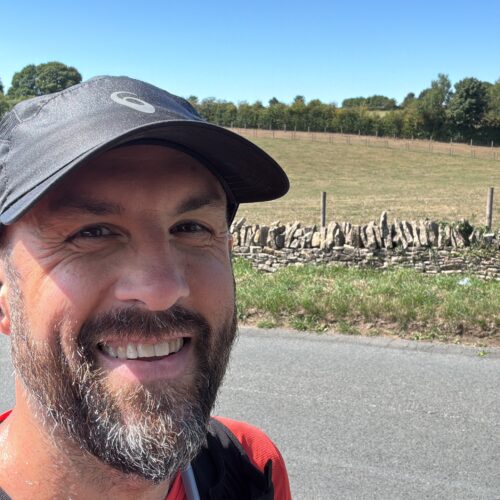
-
New Balance 1080 (road)
-
Salomon Glide Max TR (trail)
Robert Brooks: From First Steps to Coach
A Runiversary With A Six-mile Fear
Every “How It All Started” conversation has a moment where the silence is deafening because the answer isn’t tidy. Robert Brooks warned me right away: “It’s not a sound bite answer to that question.” And that’s exactly why his story belongs here.
Robert’s runiversary is April 9, 2011, the day he calls his first run “with purpose.” It wasn’t a fun little three-miler. It was a six-mile run in downtown Portland with a training group, and Robert spent the entire week leading up to it thinking, I can’t even run a quarter mile… how am I going to run six?
Then he gave me the line that every new runner needs tattooed on their training plan: “The answer was, of course, one step at a time.” Not one leap. Not one heroic overhaul. Just the next step. Then the next.
The Catalyst Wasn’t A TV Show
Before running, Robert’s life looked like what a lot of people quietly recognize in themselves. He had a sedentary routine which led to exhaustion and stress. He was carrying weight. A newborn didn’t help his sleep. Food became comfort. Days felt like repeats.
And then there was Jodi, his best friend. In 2010, she went from non-athlete to marathoner and documented the whole thing, daily, on Facebook. Photos. Workouts. Progress. Real life.
Robert had watched transformation stories on TV for years, but he said it plainly: “They were just people on a TV.” Jodi was different. She was someone he knew. and trusted. Someone he’d known since childhood. Not kidding. He knew her in Massachusetts at a young age and then ran into her in Portland, years later.
That mattered, because Jodi didn’t sell a fantasy. She showed a process.
ADVERTISEMENT

January 3rd: Five A.M. No Clue, Still Showing Up
Here’s where I leaned in, because I know what it takes to do something that doesn’t match the identity you’ve carried for decades.
Robert told me that on January 3, 2011, the first Monday of the year, he went to his local gym at five in the morning, right when the doors opened. He got on an elliptical for thirty minutes and felt awful. But he didn’t stop. Hew showed up and then he did it again the next day. And the next.
I asked him where that courage came from, because let’s not pretend it’s normal to set an alarm for pain when you’re already tired and overwhelmed.
He didn’t romanticize it. He traced it back to witnessing Jodi: “I watched her do it… and it just planted that seed.” And then he said something that hit me right in the chest: “Nobody’s coming to save me, so maybe I can save myself.”
That’s not a motivational poster. It’s a person choosing a different life.
The First 5K: Blisters, Walking, and A Finish-Line Decision
By March 2011, Robert was down about forty pounds (he started at 315 lbs.) Not because he turned into a nutrition robot overnight, but because he made small changes and stayed consistent.
He entered Portland’s Shamrock 5K mostly because his then-wife had signed up. He figured, How hard can three miles be? (Famous last words, my friend.)
About a mile in, he felt like he might have a heart attack. He walked most of the rest. He got a nasty blister. And then, on purpose, he ran across the finish line.
Not because someone told him to. Because he wanted the moment to mean something. “Run across the finish line,” he told himself. You did your first 5K.
I asked the obvious: did running bite him right away?
“Essentially, yes, without a doubt,” he said.
And then came the plot twist: a month later, he joined a marathon training program for the Portland Marathon which was only six months away. Robert is the first to admit he’s risk-averse and not spontaneous, so this was a major swing for his personality. But the facts are the facts: he went from walking a 5K to training for 26.2.
Track Nights, Community, and A New Kind Of Confidence
One thing Robert said surprised me: the Saturday long runs didn’t give him the strongest sense of community. The Wednesday night track workouts did.
At the track, people were grouped by pace ranges. There was conversation. Encouragement. Coaches who noticed you. A pace leader named Maggie who helped make the work feel possible. A coach named Christina who brought the kind of energy that makes you believe you belong even when you’re struggling.
And then Robert told me the story that’s still living in his body fifteen years later: they were doing a workout that consisted of push-ups, run 100 meters, burpees, run, and so on. At one station, he was dying on mountain climbers. Christina yelled over, telling him it was fine, he could move on.
Robert yelled back: “I’m not done yet. When I’m done, I’ll move on.”
That’s the moment running gives you when you keep showing up: the moment your voice becomes yours again.
A Half Marathon That Felt Like Flying
Robert’s first half marathon was the Helvetia Half in June 2011. it is flat farmland, then a steep climb, then a steep descent. He described two moments with clarity: joy on the top, suffering at the end.
Up on the hill, surrounded by countryside and views, music hit him in that way music sometimes does when your body is moving and your brain finally gets quiet. He stretched his arms out and felt like he was flying. It was pure freedom and joy moving through him.
Then he hammered the downhill, cramped hard, and limped the final miles.
And here’s the part I love most: when I asked him how the finish line felt compared to his first 5K, he said there wasn’t much difference. He even told me his most recent 5K (November 2024) felt the same as that first one.
That tells you who Robert is: the distance changes, but the gratitude stays.
The Marathon, The Scream, And The Cost Of Too Much Too Soon
Robert ran the Portland Marathon on October 9, 2011….the day after his birthday. At mile 15, he hit the St. John’s Bridge and tried to run again after walking… and his legs basically said, absolutely not.
By mile 22, he fell apart emotionally. He cried. He questioned when it would end. And then, within the final block, he sprinted.
He described crossing the finish line with a primal scream on his face because he couldn’t believe what he’d done. Seven months earlier, a marathon would have sounded like a dare. Now it was his reality.
But that rapid rise came with a lesson: overtraining and Achilles tendonitis followed, on and off, from 2012–2014. The turning point came after a painful half marathon where he almost dropped and then, during a four-hour drive home, he told himself the truth: he needed a real break.
He took seven weeks off, healed, and learned how to have a healthier relationship with running.
ADVERTISEMENT
Ultras, Hydration, And The Coach He Became
In July 2015, Robert ran his first ultra: Mount Hood 50K. Near the end, he intentionally looked around, trying to imprint the moment because you only get your first ultra once.
And then came the hard, practical education that every endurance athlete eventually earns: hydration and fueling aren’t optional.
Robert told me it took years, and multiple DNFs, before the message landed. The most brutal wake-up call came during a hot, exposed race near Mount St. Helens, where he became severely dehydrated, cramped everywhere, vomited, and had to be transported back to medical.
Afterward, he realized the glaring clue: he hadn’t peed once in eleven hours.
From experimentation and experience, he learned he needs roughly a liter of water per hour on hot days and he’d been taking in a fraction of that for years. Now he carries hydration even when other people don’t. He’ll wear a hydration bladder on short runs because he’s learned his body’s needs and he’s done apologizing for them.
That’s coach energy. Not the “look how tough I am” kind. The “I want you to stay safe and keep going” kind.
Jodi’s Legacy And Taking Up Space
Jodi died of brain cancer in 2018, but she never stopped being part of Robert’s story.
Three times a year (his runiversary and the summer and winter solstices) Robert runs in her memory. He talks to her. He carries a playlist that keeps their connection close. And when a friend texted him, “Jodi is proud of you,” it landed not as a nice sentiment, but as a truth.
Then Robert shared the part of his story that makes endurance sports bigger than sport. In March 2025, he left an abusive marriage. He described it as waking up and seeing clearly, while realizing he couldn’t unsee it. Days later, he got in the car and left. A few weeks after that, he got on a plane with a backpack and no plan, choosing a future that felt safer than the life he was living.
He also shared that he survived a suicide attempt about a year and a half ago, and that he carries a tattoo to mark survival and a new beginning.
I’m not telling you this for shock value. I’m telling you because it explains what running can build, over time, when you keep choosing the next step.
Robert said it best when he connected the dots back to the start: Jodi showed him change was possible. That example helped him start moving, then keep moving, then believe he could keep moving even when life got dark.
And now, Robert takes up space as a running coach not because he has all the answers, but because he’s lived the questions and learned to keep going anyway.
If you’re reading this as someone who’s afraid to start, here’s what Robert’s story gives you: you don’t need a perfect plan. You need one step. And then another. And somewhere along the way, you become the person who can help someone else start, too.
ADVERTISEMENT
