


From Bench to Marathon:
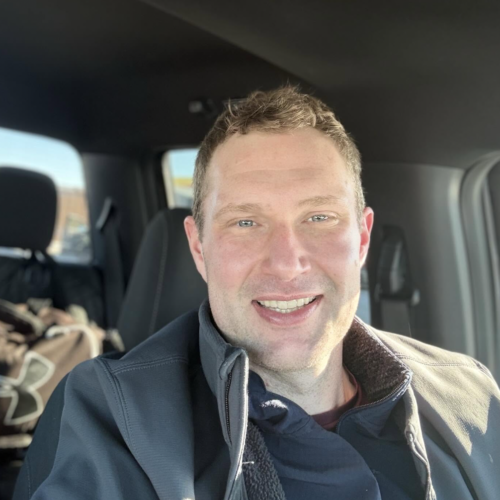
Tyler Livingston’s Running Story
There’s a bench along the Missouri River in Bismarck, North Dakota. It faces the water, quiet and steady, the kind of place you go when the noise in your head is louder than anything around you.
That bench is where Tyler Livingston found himself in 2023. And that bench is also where his running journey truly began.
I’ve heard a lot of origin stories over the years at Run Tri Bike. Some start with a dare. Others with a doctor’s warning. There are the bucket-list race stories, too. Tyler’s started with heartbreak, a milestone birthday, and a need to take control of something, really anything, when life felt like it was unraveling.
And as we often see in endurance sports, what began as survival became growth.
The Catalyst: Turning 40 and Choosing Change
Tyler started running in the fall of 2023. He had just turned 40. His marriage was falling apart and he weighed 326 pounds. Training? He hadn’t trained with intention in nearly a decade.
“I knew I needed change,” Tyler told me. “If I can take control of this one thing… maybe things are going to be okay.”
He didn’t start with a marathon or a coach. He started with a treadmill that had been collecting dust and a handwritten affirmation taped beside it:
“I will live my life with purpose, commitment and grace.”
More than an affirmation for running, this was a statement about life.
As a biotech and chemistry professional, Tyler approached his beginner running journey transformation the way a scientist would. He researched and then he experimented. From there, he built a 3-2-1 treadmill method: three minutes easy, two minutes moderate, one minute faster. He would repeat this five times. Thirty minutes total. A 5K blueprint.
He began at 3, 4, and 5 miles per hour. Then he adjusted. And adjusted again. Within weeks, he was running six miles per hour continuously. Then seven.
Progress was visible because was patient.
ADVERTISEMENT

From Treadmill to Trails
In March 2024, Tyler stepped outside for his first outdoor run.
“I remember thinking, am I really a runner?” he said. “Are people going to see me and wonder what I’m doing?”
That anxiety? Every new runner feels it. The fear of being seen before you feel “legit.”
He ran past the bench that had held his tears months earlier. This time, he ran.
His first 5K in April 2024: 28:33.
Two weeks later: 26:20.
“I got done and thought, I have more.”
He moved to a 10K and finished in 56 minutes. Then to a half marathon, finishing just over two hours. By then, he had dropped over 120 pounds, weighing close to 200.
But here’s the thing: his weight loss wasn’t the headline. The growth he was experiencing was the leading byline.
Learning Through Setbacks
No running journey is linear.
Tyler dealt with Achilles tendinitis early on. Instead of quitting, he researched heel wedges to adjust his foot alignment. Problem solved.
Later came IT band syndrome triggered by the wrong shoes and disrupted cadence. That one took longer. He changed footwear, adjusted stride mechanics, and rebuilt patiently.
“Listen to your body,” he told me. “Have grace for yourself.”
That’s a lesson that applies far beyond endurance sports.
In business.
ata-start=”3251″ data-end=”3254″ />>In relationships.
Pain isn’t always a stop sign. Sometimes it’s feedback.
Running, Fatherhood, and Mental Health
Tyler’s story doesn’t end at race times. It expands into his role as a father.
His 10-year-old daughter now runs cross-country events. He teaches her pacing and stretching and reminds her to run her own race. Sometimes that is also a reminder for himself (honestly, we could all use that reminder!)
“I truly believe I’ve become a better parent because of running,” he said.
Running gave him energy to be present. To play. To dive underwater with his seven-year-old son on his back at the pool.
It also became part of his mental health practice. Alongside therapy (his therapist happens to be a runner) Tyler found what he calls “Zen in cadence.”
“When things get hard, I can ride the wave,” he explained. “It’s temporary.”
Defining hard changed for him.
Divorce was hard.
Grief was hard.
So was mile 11 of a half marathon.
But through running, hard became navigable.
Community Changes Everything
Tyler had been “lone wolfing it” for nearly two years before discovering our community on Threads and the Everyday Athlete Clubhouse.
“I wanted a running community,” he told me. “All my running I’ve done on my own.”
The Run Tri Bike community is is entering its sixth year, and what makes it powerful isn’t mileage, it’s connection. Today, we have 125 members, coaches and nutritionists in the Clubhouse. We use Slack for daily interaction, between real humans who are answering real questions. There is also a ton of support for each other in the Clubhouse.
Tyler didn’t need validation to be a runner. But he wanted shared growth.
That’s the power of community engagement in endurance sports. It shifts you from isolated to connected. And connection fuels longevity.
ADVERTISEMENT

The Marathon and Beyond
Tyler has signed up for his first full marathon in Fargo on May 30. Flat course. Strategic choice. Scientist brain at work.
But when I asked him where he hopes running takes him, his answer stopped me and made me think.
“I hope I never find the finish line.”
That’s the mindset that sustains a lifelong running journey. Not chasing one medal or one PR. But staying curious.
He wants to run in every city he travels to for work. Maybe an Olympic triathlon one day. Maybe ultras.
Time is the only limiter.
“I want it to take me everywhere,” he said.
Lessons from Tyler’s Running Journey
If you’re starting your own beginner running journey transformation, here’s what Tyler teaches us:
-
Start small, but start.
-
Research and educate yourself.
-
Listen to your body.
-
Integrate family and community.
-
Focus on growth without needing a final endpoint.
And maybe the most important line he shared:
“It doesn’t matter the pace, the race, or the place. Just keep moving with intention. When you move with intention, you’re a runner.”
There’s a bench in North Dakota that once held a broken version of Tyler Livingston.
Now he runs past it.
And that’s the beauty of endurance sports: the places that once held our pain become landmarks of progress.
ADVERTISEMENT
