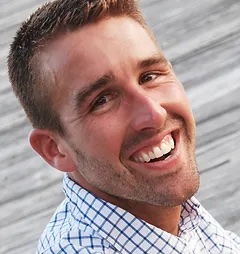


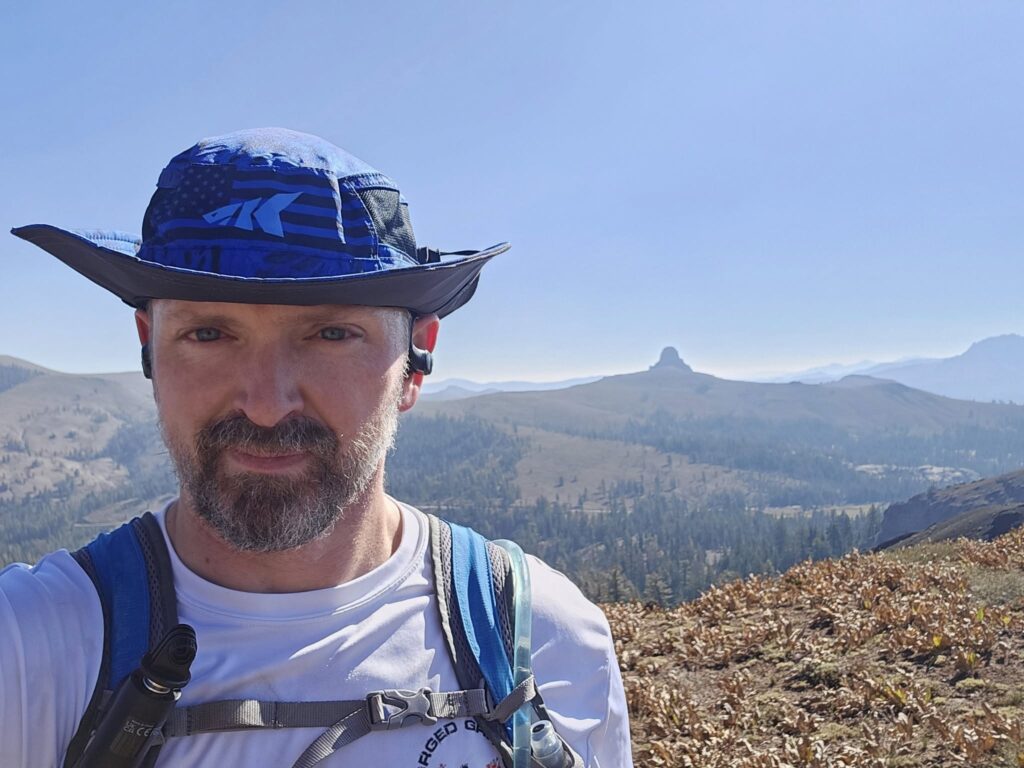
Matt Herring is no stranger to challenge—in fact, from a young age, he understood that the challenge of endurance sports was good for him. He was a severely asthmatic child, and his dad was a marathon runner. “Eventually, I started trying to do runs with him,” he says. “It was only 100 or 200 meters at first, but that distance slowly climbed up and it helped me deal with a lot of the lung problems I had.”
A Love Of Endurance Sport
By 17, he had found a love of trail running (“I have always been a bit of a trail runner since I got into it,” he says) and ran his first 50K, the Quivering Quads Trail Race in Missouri. From there, Matt and his dad got into adventure racing, and after moving out west, started to do more 50Ks and 50-milers.
Then Matt saw his next opportunity for endurance sports to help him grow: When he relocated to California to do his PhD, he joined a triathlon team. “I did that primarily because I actually had a fear of water and I wanted to learn to swim,” he says.
That was just the beginning. Matt discovered he loved the way physical challenges shaped who he was as a person, testing both his body and mind. He began to mix his endurance sports with powerlifting and CrossFit. “I always like to push my limits, to see how far I can go,” he says. “I’ve always had that endurance mindset—I was like, ‘I don’t want to do just a 5K, I want to see how far I can go until my body and my mind collapse.”
ADVERTISEMENT
JOIN THE EVERYDAY ATHLETE CLUBHOUSE AND SAVE 15% ON PATH PROJECTS APPAREL

The Biggest Challenge
Matt went up against his greatest mental and physical challenge 10 years ago when he was doing post-grad work in Florida and a T-bone car accident sent him to the hospital. “I woke up the next day, and my pelvis was broken in two places, and all my ribs on my left side were broken; I had bruising all over, and one heck of a concussion. I actually lost some of my memory because of it.”
But despite the injury, he felt determined. While he was still recovering in the hospital, he registered for the St. Anthony’s Olympic Triathlon that was only three months away and told his coaches he was going to do it. Within two weeks of getting out of the hospital, he was back at the gym. His coaches wouldn’t let him use his legs right away, so he worked the rowing machine to get his aerobic capacity back to where it needed to be. He also used weighted squats and kettlebell swings to rebuild his abdominal structure. “I probably didn’t start running until like two or three weeks prior to the race,” he explains.
Through it all, the mental challenge of wanting to run and not being physically ready was the hardest part. “You’re mentally ready,” he says. You know how to do it mentally, like you’re ready to fight your way back to where you were. So it’s just getting your body to cooperate; that was actually probably the hardest thing.”
Focus On Why
Matt has started a YouTube channel, @ForgingGrit, where he helps others understand not only how to train but also why to train. As he discovered firsthand, training physically helps prepare you for those times when you find yourself up against adversity.
“Life is going to punch you in the face,” he says. “It has definitely punched me in the face a lot. When you train, you put yourself in kind of a controlled suffering state. You choose your suffering. You choose how to go through the pain. … So then the next time life punches you in the face, you know this is how you handle it. By training in those states and those discomforts, you will teach yourself how to handle life better.”
As for advice he would offer new runners? He says to accept your identity as a runner even if you don’t think you’re very good at it yet. Once you’ve done that, the behavior will naturally follow. “But it starts with believing you are a runner,” he says.
ADVERTISEMENT