


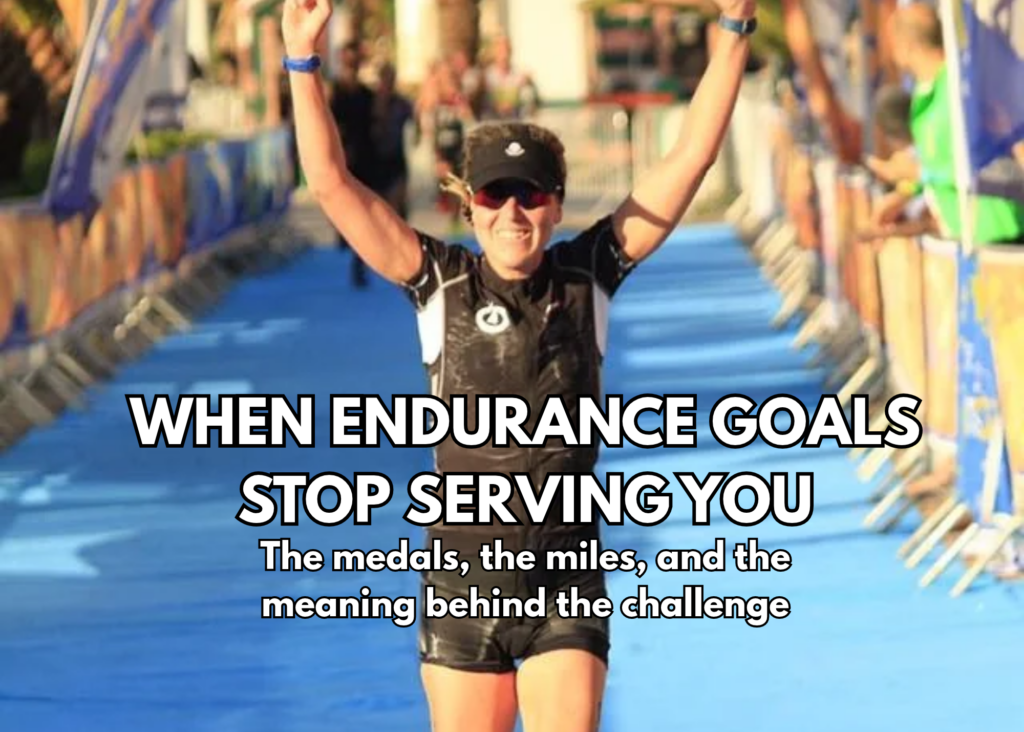
What we are chasing, and why, can look very different over time?
The finish line moment has changed. The ribbons and medals were my WHY as an age group swimmer, the full ride scholarship to swim at EMU was the WHY, the PRs in running and triathlon were the WHY before hitting age 50, and the desire to push my limit has always been the WHY.
Clearing out my moms home before the move, memories looking through boxes of medals and ribbons, especially remembering wanting the pink ribbon, that often meant finishing sixth instead of top 3, did not matter, I wanted that ribbon.
For 30 years, triathlon success was measurable by a faster time and/or a podium finish. Now, I check if off every year to maintain my streak.
Goals give us direction, completing a challenge is rewarding. But after decades in endurance sports, both as an athlete and a coach, I’ve started thinking differently about what we’re chasing and why.
When Endurance Sports Goals Become Expectations
I read the discussion about the relationship between ambition and endurance sports that made me reflect. Specifically, when does the desire to accomplish something become an unhealthy need to prove something?
My mind immediately went to 2023, putting Ironman on hold and pursuing Ultra running, 100-200 mile events were on my training peaks calendar, it was hard to break away from multisport and just focus on running, therefore excessive training, disordered eating, and the pressure I put on myself to be a champion Ulta runner like I was a triathlete.
Chasing big mileage until I could not, I broke my patella March 2023, during my recovery I had no desire to attempt more than a 5k, and from my perspective I don’t have anything to prove to anyone. (Remember, as an age group swimmer, I swam for my coach and parents, not myself) That mindset carried over a little bit as an Ultra runner
Who Am I Trying to Prove Something To?
Who are these people living in my head that I’m trying to prove something to?
Ambition isn’t inherently unhealthy. But when our identity, self-worth, or happiness becomes dependent on accomplishing the next big thing for someone else to see, it’s worth stepping back.
ADVERTISEMENT

Redefining Athletic Success as We Age
I rode the speed plateau in my 40s and accepted the slow down in my 50s and stopped comparing today’s performances with what I did ten, or twenty years ago.I set new PRs in each age group and don’t wonder why I can’t quite reproduce results like I did in my 30s and 40s. There is confidence in knowing that I will come as close as I can and don’t stress about becoming slower because now, I want to continue to be active and mobile as I age, maybe Kona again sooner rather then later. Maybe, when I turn 85 if evert female has finished in the age group, maybe it will be me
Recovery, Fueling, and Long-Term Health
Success now is training around recovery, a healthy relationship with food, lets gain muscle mass means fueling differently than trying to lose weight. Remain competitive without sacrificing my mental or physical wellbeing.
I will chase PRs in the longer events I am still new at, 50s, not the 5ks. I will be grateful to be as fast I can be on the given day, a strong finish and then maybe the masters win, not overall podium
Finding New Challenges Beyond the Podium
And, I appreciate things I might have overlooked earlier in my athletic career.
Not slowing down much as a swimmer, a little consistency gets me close to where I was in my younger days. I have the mental and physical strength to tackle mountainous terrain. I have goals to learn how to dance and play tennis because I know a balance with activity will allow me to continue doing this for another 3 decades. And, most importantly, since 2023, I know when to back off.
ADVERTISEMENT