

The Mission:
Sierra was part of a group of 4 friends who entered the Orcas Island 50K lottery together for the event in 2019. The race rules stated that if one member of a group won the lottery, they were all in– so they were upping their odds. The race is right around Sierra’s birthday in February, so she was thrilled when she learned that she had been picked in the lottery and they would all be celebrating her 39th birthday at the race.
She’d run a couple of 50k races and fun runs before, so knew that she could do the distance, but this race boasts over 7000 feet of gain, and is known for its grueling climbs. Sierra knew this would be a challenge, so wanted to set herself up for the best possible outcome. Having a lifelong history of gut problems, and a few previous “gut bomb” incidents during runs, she spent the days leading up to the race eating only foods she knew were safe for her– even foregoing the pre-race spaghetti dinner in favor of a bowl of granola and yogurt.
ADVERTISEMENT

The Attempt:
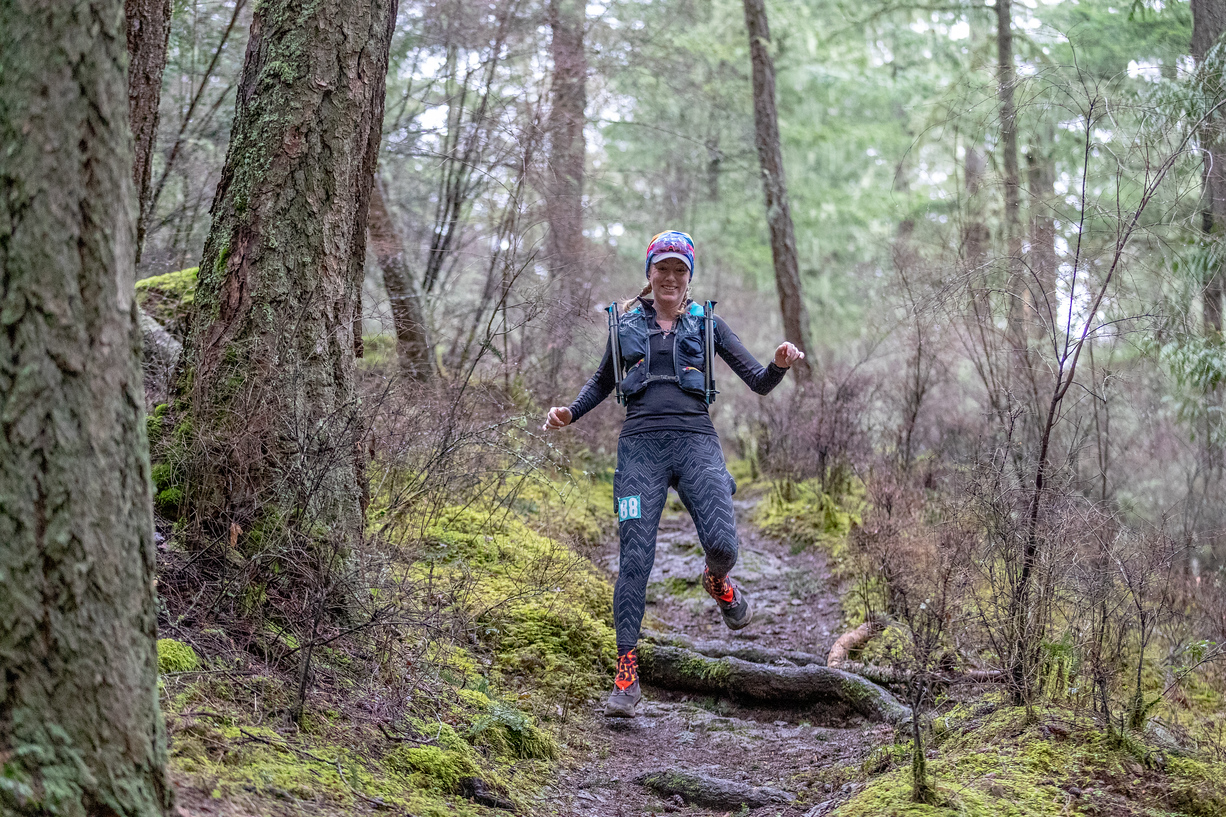
The morning of the race kicked off as would be expected. Cool February temps in the Pacific Northwest made for perfect running conditions. Sierra took off a comfortable pace near the back of the pack. She had strategized to take the first few miles easy, to save her energy for the big climbs which would come later. Sierra and her three friends each found their own rhythm and pace, knowing they would meet up again at the finish line.
She and the other runners wound through beautiful old growth forest, so many shades of green between the trees, moss, and forest floor, a barely noticeable PNW mist hanging in the air. She navigated the rocks and roots with ease, reveling in the soft cushion of the trail.
Around mile 5, a familiar gurgling feeling arose in Sierra’s gut. Oh no. I’ve done everything right. I even pooped this morning before we started. The feeling was not yet emergent, so Sierra reasoned that she could make it to the second aid station, only a few miles away, where there would be port-o-potties. She continued to run, a little slower than before, hoping that her stomach would settle and that she could make it down the trail.
When she arrived at the spot on the map where the aid station was supposed to be, it wasn’t there. She stood for a few moments, trying to make sense of this unexpected turn of events. When a pair of young men caught up to her there, she asked, “Isn’t the aid station supposed to be here?” They agreed, but shrugged their shoulders and kept running.
As Sierra reluctantly continued down the trail, she started looking for a place to pull off and dig a hole. Unfortunately, the trail wound between a lovely burbling stream on one side and impressive rocky cliff faces on the other. There was nowhere to go. Several times, she thought she had found a possible place, and wandered off trail only to find her path blocked. Now in a desperate state— finally, after several attempts and nearly 20 minutes wasted, Sierra found a spot behind a large tree where she could dig into the earth and relieve herself.
When she was finally back on trail and moving forward, she wondered how far the next aid station was, where it was, how long it would take her to get there. The cut-off time was fast approaching. She was sure that she had missed the aid station altogether and wondered if she was even still on the race course. So she trudged along, in low spirits.
The Call:
To her confusion, somebody appeared on the trail headed toward Sierra, and shouted, “You’re almost there! You’re so close.” They cajoled her into a trot, and she hustled into the aid station just as the cut-off bell rang. An aid station volunteer informed her that her race was over.
“But I don’t need to stop! I’m just going through.” Because of her known stomach issues, she was carrying plenty of snacks and didn’t need anything from the aid station. But the rules were the rules, and the rules stated that runners must be TO and THROUGH the aid station by the cutoff time. So the volunteers and aid captain were not going to let her go on.
Tears welled in Sierra’s eyes. She wasn’t ready to stop. This was all a misunderstanding. The aid station wasn’t where it was supposed to be. She had wasted so much time trying to go to the bathroom. She could make it up. But she wouldn’t have the chance. Her race was over.