



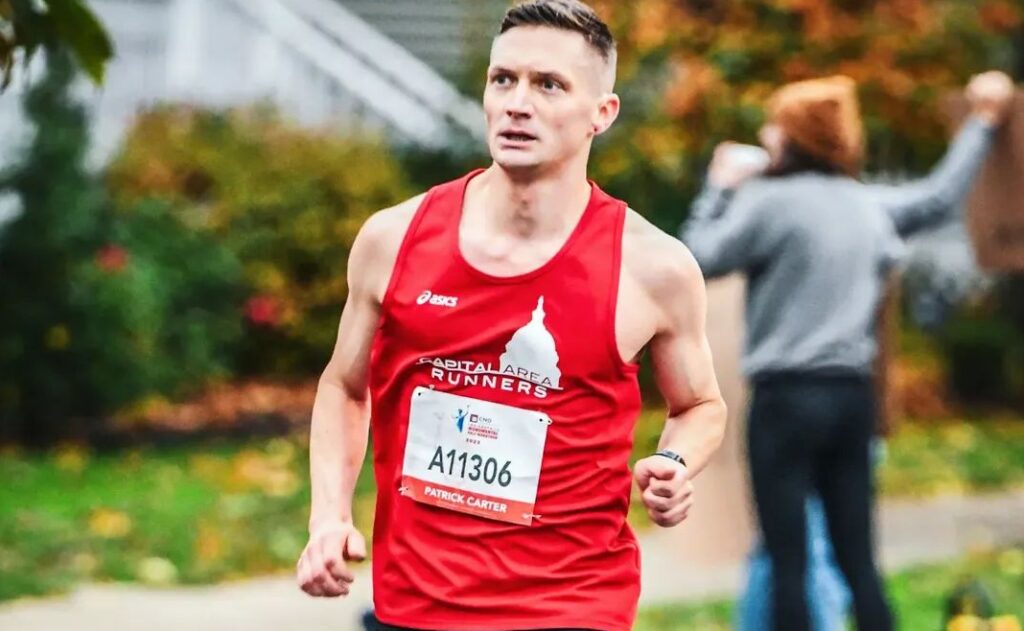
Running came to Patrick through time spent learning how to get better. Growing up in Bloomington, Indiana sports were encouraged but not forced. Over time, his journey in the sport was shaped through college competition, military service, injuries, and long periods of rebuilding.
We talk to him through progression from middle school cross country to the present and everything in between from injury, heartbreak, and PRs.
Where did you grow up, and how did running first enter your life?
I grew up in Bloomington, Indiana, whose parents valued education and participation in activities. I did not show much promise in sports early on. I played basketball until sixth grade, and when I decided to stop, my mom suggested focusing on cross country and track since I had already run with my elementary and middle school teams. I was not very good at first, but I made big improvements in the offseason while running with Indiana Track Club, a kids program through Indiana University. By seventh grade cross country, I was running first or second on my middle school team and knew I wanted to continue.
Once I committed to running, I stayed with it. I ran in high school and eventually in college at Wabash College, a Division III school in Indiana. Even early on, I knew longer events suited me better. My college coach told me he thought the marathon would eventually be my best event.
How did your time in the Navy shape your running, both in setbacks and progress?
Training on active duty was inconsistent. During my first tour, I was deploying, doing exercises constantly, and dealing with injuries. I do not think I ran more than forty miles per week consistently for about three years, and I largely considered myself out of the sport.
In 2019, I went to Naval Postgraduate School in Monterey, California, and running restarted. I signed up for CIM with about five months to build from essentially scratch. I topped out around fifty miles per week but the consistency of graduate school helped. I ran 2:52 at CIM despite a rough build, limited fueling knowledge, and a big positive split.
During COVID, I regained consistency. In fall 2020, I was stationed in DC and joined my current club. My final Navy tour was another shore assignment in DC with traditional hours and a supportive boss. Training at a high level in the military can work, but it depends heavily on job, location, and factors outside your control.
ADVERTISEMENT

What does your training look like now, and how do you judge whether a block is going well?
I typically do intervals on Tuesday mornings, three to five miles of quality with active recoveries. Fridays are tempo runs of five to eight kilometers, progressing from marathon pace to ten-mile pace. Long runs are on Sundays, usually twelve to sixteen miles outside of a marathon build.
I train with Capital Area Runners in the DMV. Our coach sets the workouts, and the group is mostly working professionals who train seriously and value structure.
A good training block is one where I feel confident in workouts and can progress paces within sessions. I try to run slow to fast and finish feeling like I have another rep left. Easy runs matter just as much. When easy runs actually feel easy and do not hurt, it takes pressure off everything else. I do not believe in perfect marathon blocks. Something always goes wrong, and when it happens early, it can almost be a relief.
In 2022, my fiancée left me four weeks before CIM. I was in a difficult place emotionally, but I poured everything into running. I ran 2:34:13 with a two-minute negative split, running the first half with the women’s OTQ pacers and pushing hard over the final ten miles. That race was faster than my A goal and changed how I saw myself. My next target race saw my half marathon best drop from 1:16:03 to 1:12:34.
Injuries have been a recurring part of your career. How has that changed your approach?
The hardest stretch was during my first Navy tour, when repeated stress fractures kept me from stacking training. There was a period where I thought I would never compete seriously again. Being able to change roles helped reset things.
I still struggle with knowing when to push and when to pull back. Like many competitive runners, I let problems go on too long. I am trying to be more proactive with regular physical therapy check-ins so small issues do not escalate. One downside of military life is long Tricare treatment timelines, which can incentivize you to ignore issues you think you can run through.
Is there an athlete who has influenced you?
I admire Susanna Sullivan, who ran with my club before becoming a professional. I knew her before her breakout performances and saw the work behind them. In 2022, I joined a club training camp in Bar Harbor, Maine, and spent the week getting dropped by her in workouts while she continued cross-training afterward. It was humbling and showed me what a true professional looks like. I also learned a lot from aqua jogging with her, which she uses extensively.
ADVERTISEMENT

How do you mentally handle longer injury periods?
I break injuries into smaller milestones. Thinking about returning to PR shape is overwhelming, so I focus on steps like starting to run again, moving from walk-jogs to continuous runs, and eventually adding intervals. It is still hard. Recently, having friends to cross-train with has helped keep me from dwelling on it.
What are you training for right now?
I am training for indoor track races and road ten-milers, including Broad Street and Cherry Blossom. I am also in a graduate program with UVA, so track races will be with their run club. After several injuries this past year, the goal is to build toward a marathon this summer. If things go well, I will try for a Grandma’s bib transfer.
Why has the marathon become your main focus, and what comes next?
The marathon is where I have the highest ceiling. I also prefer the mental side of it. It is a slow burn that requires patience, and the ups and downs during the race allow for adjustments that shorter races do not.
I am starting a new stage of my career at the end of January, which will add new balance challenges. My main goal is to break 2:30 in the marathon. My personal best is 2:33:17 from Valencia in 2023. I deferred my Marathon Project entry to 2026 because injuries made 2025 unrealistic, and that race may be the right opportunity.
You can follow Patrick on Strava and Instagram.
ADVERTISEMENT