


The Mission:
Lynn Rogers had completed Ironman Wisconsin in 2016. But a lot has happened since then. In 2017, just days before Lynn was set to fly out for Ironman Canada, she started to notice that her body was acting strange. Several doctors’ visits later, she had no answers as to why her physical strength was deteriorating. Confused, but hopeful, she boarded a plane to Whistler anyway. In the next few days, weak muscles turned to full paralysis. She was hospitalized in Canada as her competitors toed the starting line.
With an initial diagnosis of Guillan-Barre Syndrome, doctors treated Lynn to regain some of her motor control. Just as it seemed things were getting better, her symptoms would worsen again. She was transferred to the hospital where she worked as a medical researcher in Chicago. After four months in hospitals Lynn finally went home with a diagnosis: Chronic Inflammatory Demyelinating Polyneuropathy (CIDP). In the following years she faced huge swings in her physical abilities, recovering well enough to run a marathon in 2018 but then regressing again. Her doctors helped her navigate a series of treatment protocols, experimenting to find ways to relieve her worst symptoms and allow her to return to the active life she had once known and loved.
When Ironman Barcelona 2022 came onto Lynn’s radar, it felt universally aligned. There was a doctor she wanted to see in Barcelona who specialized in the particular nuances of her manifestation of CIDP. Athletic Brewing Company had offered her a sponsored spot in the race. She was ready for a comeback. She wanted to stand in front of the world and defy the belief that people with CIDP shouldn’t push themselves “too hard” physically. The only thing missing was her training foundation. She began preparing right away.
ADVERTISEMENT


The Attempt:
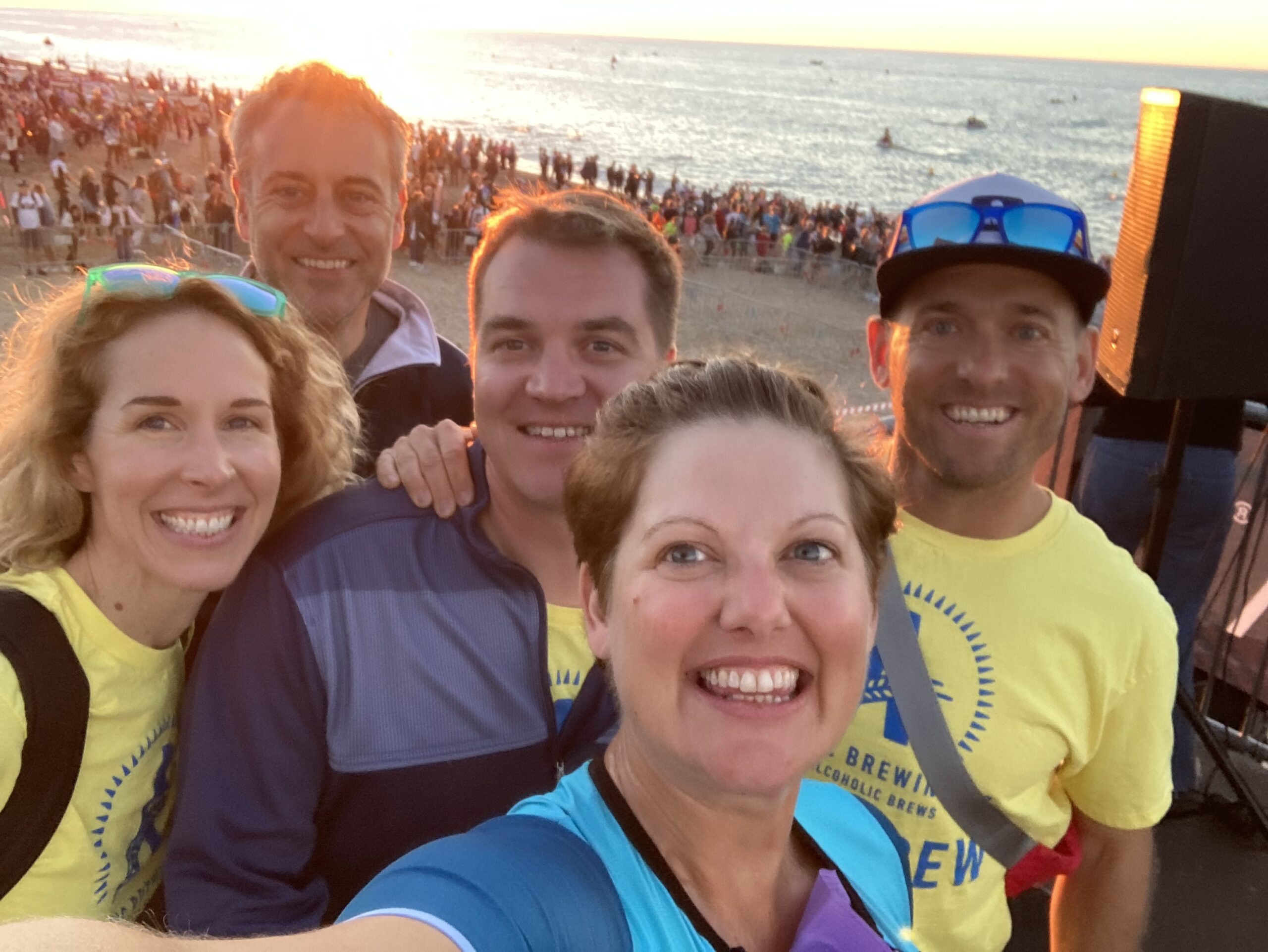
Lynn stood at the edge of the Mediterranean Sea. Dozens of waves of swimmers had already taken off in the open water, swimming against the current. Lynn reached up for one last high five from her family and friends who stood on the VIP platform just above the sand. With a smile, she headed into the water. She marveled at how clear the water was, catching glimpses of the gentle ripples in the sand at the bottom of the ocean, all wildlife having cleared the area once the swimmers had begun. Lynn thought of the choppy, cold water of Lake Michigan near her home in Chicago, and the trash and debris at the bottom.
As she swam parallel to the shoreline, waves rocked Lynn’s body from left to right. A dizzy, nauseous feeling came over her—seasickness. Other swimmers glided by Lynn as she alternated between admiring the beauty of the ocean floor and vomiting into the clear Mediterranean water. She knew her pace had slowed. She thought of the carb-loading meal she eaten the night before. She thought of her family waiting for her to exit the water. Hopefully they wouldn’t be worried. She wasn’t dying… just puking. She just needed to get through this and she could hop on the bike and leave the nausea behind.
When she finally reached the end of the swim and staggered out of the water, Lynn could hear the announcer telling the crowd that she, Lynn Rogers, one of the Athletic Brewing sponsored athletes had just finished the swim. Cheers rang out, and Lynn felt all eyes land on her. In that moment, she could not stop the inevitable. She leaned forward and vomited spectacularly on the ground. The announcer quickly moved on to direct attention toward someone else, anyone else.
In the transition area, Lynn peeled off her wetsuit to reveal her Athletic Brewing branded kit. She tried to eat, drink, and replenish electrolytes. She took her time in transition— knowing that she needed to recover from the brutal swim experience that had her feeling depleted. There was still so much race ahead of her. But there is only so much you can do midrace and a body with autoimmune disease does not reverse course quickly once things start unraveling. But Lynn had been through a lot, and she knew what it was to push through a little suffering. She was mentally tough.
Once she mounted her bike and began to pedal into a stiff beachy headwind, Lynn knew she was in for a struggle. She pushed like she was climbing straight uphill, but the course was nearly flat. Her legs locked up from the effort, something she had only experienced in training when she attempted an FTP test—which she had determined was too strenuous and sustained for her post-diagnosis body. But she should be feeling that way now, not at this level of output. Several times during the first 30 miles of the ride, Lynn got off her bike and lay by the path to rest. On the only true uphill portion of the course she was forced to dismount her bike and push it. She had never needed to do that before.
The Call:
When the course turned back on itself, Lynn felt the joyous relief of a tailwind pushing her toward the halfway checkpoint where she would start a second loop. Suddenly her legs were working again, just not so hard. In the next 20 miles, Lynn recovered her energy and her mindset. She felt ready to grind against the headwind again. But she wouldn’t be allowed. She had missed the cutoff.
At the checkpoint, Lynn had to turn in her number and end her race. She knew that, given the time, she could have completed the race. She was struggling, but isn’t that what Ironman is all about? She thought about her sponsorship and all her friends and family who had traveled to Barcelona to see her big comeback. She remembered the races she’d completed since her diagnosis and recovery. This was her first DNF.
Lynn and her crew stuck around for a while to cheer on some of the other Athletic Brewing athletes and soak in a bit more of the race atmosphere, before heading back for a family dinner. She was surrounded by laughter and community. Nobody was disappointed that she hadn’t finished the race—they were proud to see her try.
ADVERTISEMENT
.png)
Lessons Learned:
As Winston Churchill said: “Success is not final, failure is not fatal.” – Every success and every failure is a step in the process. There is always something next. In science and in sport, you learn more from the times when something goes wrong and you must problem-solve toward a solution.
Improve your probability of success in every small way that you can. – Over the next couple of years and another Ironman DNF, Lynn fine-tuned all controllable variables, because her CIDP was the biggest uncontrollable variable there was. She dialed in her fueling and experimented with her medical treatments to understand how their side effects affected her ability to race. She even added specific training, like strengthening her neck muscles like a wrestler and a racecar driver to hold her neck up while on the bike.
Our abilities and limitations, especially as an athlete with chronic illness, are profoundly personal. – Doctors are working with the information that they have available, but often there aren’t many data points when it comes to chronically ill patients running, biking, and swimming. So we must test our own limits to learn what is possible.