



Doctor Dad Chasing Marathon Stars
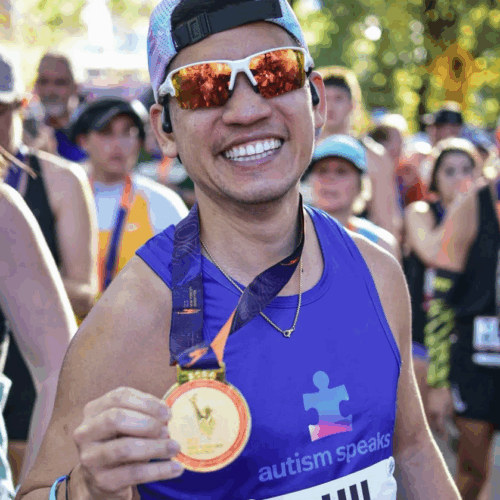
Phil dela Merced practices medicine in Northern Virginia and parents a curious three-year-old. He’s also the kind of runner who can laugh at himself while asking big questions: What matters most today…..10 miles or reading a bedtime story? Can a three-hour treadmill session help you keep your cool in a tough clinic day? And how do you run toward big goals without losing the joy that got you started?
Phil’s story is a grounded look at how endurance sports can free us, not by removing life’s demands, but by helping us move through them. And do it one step at a time. As he likes to say, “Take the next step.”
How It Started: A Half, No Plan, Big Lesson
Back in 2017, during medical residency, Phil signed up for the Detroit International Half Marathon. Training plan? Not really. Longest run before race day? “Probably about five miles, which was definitely not sufficient,” he says with a grin. The goal shifted mid-race from “do great” to “just finish.” He did finish, and the spark stayed lit.
Running during residency gave him more than medals. “It was a good centering tool,” Phil says. “I’d do a run and then sit down to read and study. It helped me focus when I was exhausted.” That simple link, move the body, settle the mind, became the start of something that kept showing up as life changed.
The Six-Year Gap: Life First, Then 26.2
Between that first half and his first marathon in 2023, life moved fast: finishing training, a cross-country move, marriage, and parenthood. He didn’t rush the jump. “It wasn’t patience; life just happened,” he says. “Once things settled, I revisited running and the marathoning kicked up.”
Those years taught him that timing isn’t only a number on a watch. It’s also family schedules, hours in the OR, and sleep. Endurance sports can wait while the bigger picture takes shape. When he finally returned to longer distances, he did so with a steadier sense of who he was running for, himself and his family.
ADVERTISEMENT
JOIN THE EVERYDAY ATHLETE CLUBHOUSE AND SAVE 15% OFF YOUR PATH PROJECTS ORDER.

The Mantra: “Take the Next Step”
Phil’s anchor phrase shows up when things get hard. During the 2023 Marine Corps Marathon, a hamstring pop at mile 18 forced a rolling audit of what was smart. “Let’s see what this next step looks like… this next half mile… this next mile,” he told himself. He finished. It wasn’t the sub-4 he hoped for, but it was a master class in listening, adjusting, and staying present.
That same mindset crosses into the hospital. “Knowing I can run on a treadmill for three hours without losing my marbles helps remind me I can handle hard moments with patients, too,” he says. Endurance teaches the mind to sit with discomfort and still make good choices, on the course and off it.
Family, Work, and the Training Puzzle
A typical training week for Phil is a living puzzle. On paper: a 10-mile run at 8 a.m. In practice: “I’m on dad duty. Princess time comes first. Let’s move the run to another slot,” he says. The goal is to make the miles fit the life, not the other way around. “If I force a workout and let the other pieces fall, it stops feeling good. I’d rather do both, it’s just not always as planned.”
His husband isn’t a runner, but he gets it. “I’ll say, ‘I’ve got a 20-miler,’ and he’s like, ‘Cool, see you in a few hours—finish when you can.’” That support matters, especially on long-run days when hours stretch. Clear talks and real expectations make the house hum and the training stick.
And their daughter? She sees it all. “Every run is a chance to show her that hard things can happen,” Phil says. “She’ll ask, ‘Dada, are you going on a run today?’ It’s important that she sees it’s good for health and it’s a challenge worth doing.”
From “Just Finish” to Feeling Strong
Marine Corps gave Phil the finish line lesson. New York City gave him the feeling. Healthy and ready, he returned to 26.2 and notched a massive 28-minute PR. But the time wasn’t the headline. “I barreled through still standing on two feet…..no limp, breathing great,” he says. “I felt like a strong runner. The feeling mattered more than the number.”
That shift, from chasing a clock to chasing how he wants to feel, isn’t soft. It’s smart. He still sets goals and tracks splits, but the test now is whether he can cover the distance with strength left in the tank and pride in the effort.
Social Media, Supportive Spaces, and Running Your Own Race
Like many of us, Phil has scrolled himself into doubt. He solved it by curating what he lets in. “If it doesn’t serve you, unfollow it,” he says. “Some accounts lift you up; others turn your wins into noise. Protect your joy.”
He also looks for signs that a space is truly welcoming. That can be as simple as a pride flag in a logo or a brand that backs words with action. “Seeing clear signs of inclusion tells me it’s safe to show up,” he says. Orange Theory became a fitness family early on, and online running groups and online running groups, such as Run to the Finish and coach Alison Staples, gave him a place where identity never discounted achievement.
He’s honest about the comment-section mess that can follow queer athletes, especially in non-binary race news. His practice: focus on the athlete, skip the poison. “Celebrate the achievement and keep moving,” he says. The win is the point.
Why He Keeps Going: The Six Stars and the Daily Why
Phil’s long view is the Abbott World Marathon Majors Six Star. It’s structure and a spark that lives past a single season. But the daily why is smaller and closer: show up for his daughter, keep his mind clear for his patients, and prove to himself that he can do hard things. “At the core, it’s the personal challenge,” he says. “A reminder that I can still do it.”
That personal challenge isn’t selfish; it spills over. A calmer dad after a long run. A steadier doctor after a weekday tempo. A kinder voice in his own head when life gets loud.
Advice for the Endurance-Curious
Phil’s start line advice is simple and generous. “Take the first step and see what happens,” he says. If 10 minutes of walking is new, do 11 next week. Then 15. Keep stacking tiny wins. “The personal joy is yours. No one can take that away from you,” he adds.
He also suggests pacing your comparisons. Follow folks who inspire action, not doubt. Mute the rest. And remember that your race is, well, yours. The finish line cheer feels the same whether the clock says world record or personal best.
Freedom, Found in Small Steps
What makes running feel like freedom for Phil isn’t escaping life; it’s engaging with it. Runs are not breaks from being a doctor, a husband, or a dad. They’re the thread that helps tie those roles together. On some days, that thread is a pre-sunrise 10-miler. On others, it’s a quick loop at lunch or a treadmill jog after bedtime stories.
“Let’s see what the next step looks like,” Phil says. It might be the next mile or pausing to heal. It might be waving to family at mile 22 and finding a friend to carry you to the line. Wherever it leads, that step is the work. And the gift.
ADVERTISEMENT
